
Rafael Hughes · 9 October 2026
Sensor Integration Strategies for Monitoring Reciprocating Component Behavior in Dynamic Load Scenarios
Reciprocating components such as pistons and connecting rods operate under constantly shifting forces, and engineers rely on integrated sensor systems to capture real-time data on stress, vibration, and displacement, while data from these systems supports predictive maintenance schedules across industrial and energy sectors.
Core Principles of Sensor Placement in Reciprocating Systems
Placement strategies begin with mapping high-stress zones along the component surface, and accelerometers positioned near the wrist pin area record rapid changes in motion while strain gauges mounted along the rod length measure tensile and compressive forces during each cycle, yet temperature sensors placed at the crown help account for thermal expansion that can skew mechanical readings.
Researchers have found that combining multiple sensor types at complementary locations reduces blind spots in the data stream, and wireless nodes now transmit readings without adding significant mass to moving assemblies, although power management remains critical because battery life directly affects monitoring duration in continuous operations.
Handling Dynamic Load Variations Through Adaptive Sampling
Dynamic load scenarios produce irregular force peaks that standard fixed-rate sampling often misses, so adaptive algorithms adjust acquisition frequency based on detected thresholds, and this approach lets systems capture detailed waveforms during sudden load spikes while conserving bandwidth during steady-state periods, whereas traditional fixed sampling wastes resources on repetitive low-variation data.
Engineers integrate these adaptive methods with edge computing units mounted close to the machinery, and the units perform preliminary filtering before sending summarized packets to central databases, but synchronization across multiple components requires precise timing protocols to align datasets from separate reciprocating assemblies operating in parallel.
Data Fusion Techniques for Comprehensive Behavior Analysis
Raw outputs from vibration, pressure, and displacement sensors arrive in different formats and sampling rates, and fusion algorithms merge these streams into unified models that describe component behavior under varying loads, while Kalman filters and machine learning models help reconcile discrepancies caused by sensor noise or minor calibration drift.
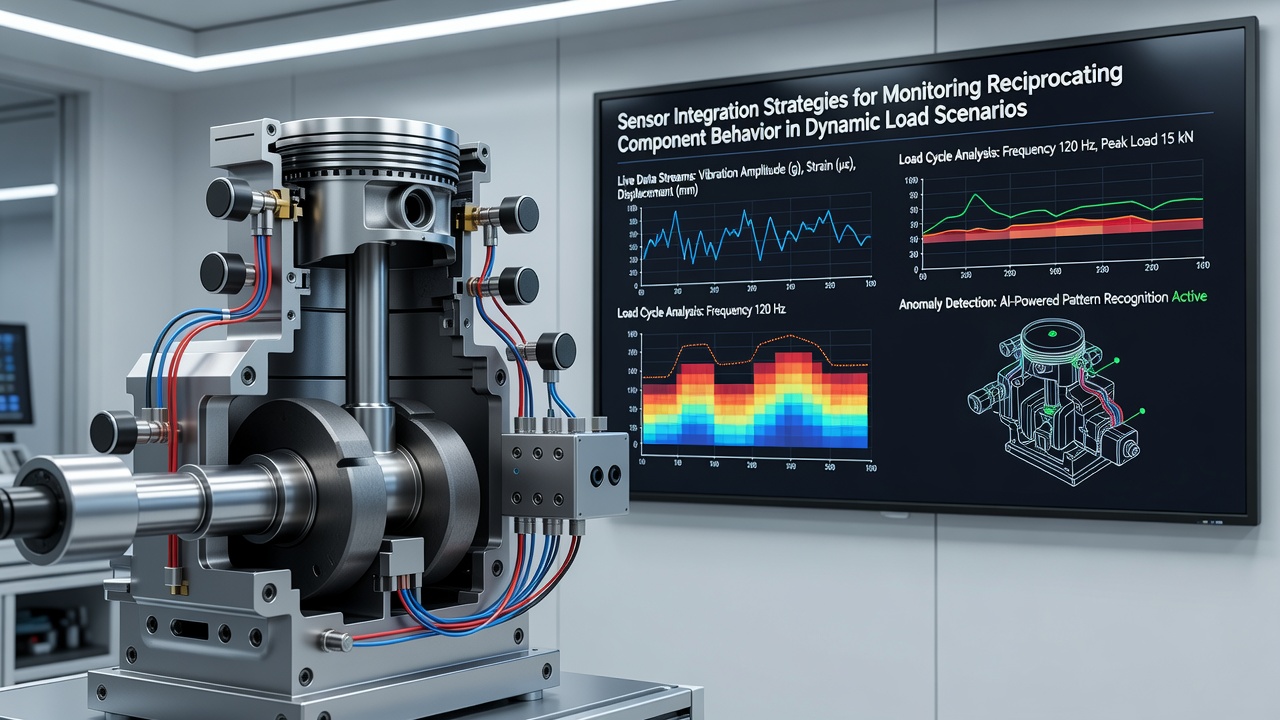
Studies conducted by teams at the National Institute of Standards and Technology show that fused datasets improve fault detection accuracy by 25 to 40 percent compared with single-sensor monitoring, and similar findings appear in reports from the Commonwealth Scientific and Industrial Research Organisation in Australia where long-term field trials tracked compressor pistons across fluctuating pressure cycles.
Challenges in Harsh Operating Environments
Extreme temperatures, corrosive fluids, and high-frequency shocks create ongoing obstacles for sensor longevity, and protective housings plus specialized coatings extend operational life yet add complexity to signal transmission paths, although recent advances in ceramic-based sensor elements have reduced failure rates in environments exceeding 300 degrees Celsius.
Calibration drift occurs faster under repeated dynamic loading, so periodic self-check routines using reference signals help maintain accuracy without full system shutdowns, and maintenance teams schedule these checks during planned downtime windows to avoid production interruptions.
Integration With Broader Industrial Monitoring Networks
Sensor data from individual reciprocating units feeds into plant-wide condition monitoring platforms that correlate component behavior with overall process parameters such as flow rates and energy consumption, and this holistic view supports decisions on load balancing across multiple machines, while standardized communication protocols like OPC UA ensure compatibility between equipment from different manufacturers.
In October 2026, several European research consortia plan to release updated guidelines on sensor network architectures for heavy machinery, and these documents are expected to address interoperability issues that currently slow large-scale deployments in mixed-vendor facilities.
Conclusion
Effective sensor integration for reciprocating components demands careful attention to placement, data handling, and environmental resilience, and organizations that combine proven hardware strategies with adaptive software techniques gain clearer insight into component performance under dynamic loads, while continued refinement of fusion methods and network standards promises further gains in monitoring reliability across industrial applications.